Compunction

Courtesy Sharon McCutcheon Unsplash.com

Author’s Note: Corrine and the narrator here are current characters in progress for my next body of work. I hope you enjoy


I have no compunction to acquiesce to her wishes. Despite the provocation, I still love her. It is a dilemma.
The night surges around me like a redundant coal mine, the memories of such excavations as to tire an army of dwarves recalled, but discarded. It closes in. I am surrounded.
Her eyes appear first, always her eyes, flashing from this false midnight like two black holes. They hover, darker than dark, drawing in those vestiges of light surface dwellers take for granted, gorging. I would have them gorge on me, too, but have not the energy to ask.
Corrine has a flair for the dramatic, always had, in both life and death. She whispers sweet promises, offers life eternal, a never-ending dream, but is this not what God promises, too? Whether corporeal or incorporeal, one exists. The only decision to make, one unfortunately decided whilst the former presides, is where.
This deep darkness pools like a subterranean sea, tugs with a relentless persistence, one which wears. I capitulate. Corrine wins.
She is here, everywhere. I breathe her, filling my lungs with sorrow. She circulates my system, sluggish in blood made unctuous, taking a slow perusal of all I have to offer. I have nothing to offer, but it still takes time.
When I wake, it is to her raven self. She looms over me in a burgundy chamber, lit by a single black candle with a putrescent flame.
“Make it easier on yourself,” she coos, like a demented dove.
“No.”
“I ask nothing.”
“You ask everything.”
“I could take it.”
“No, my once darling, you cannot.”
I lay for interminable aeons debating this simple truth, as the cosmos unfolds around me, suns blinking in and out of view, universes unfolding like paper swans set loose in time’s ocean. She thinks it will break me, but it only strengthens my resolve. She should never have awoken me.
Corrine enters my perfect prison with a cup of cold water. Condensation drips down the glass like diamonds-made-emeralds in the unnatural light.
“Drink,” she says.
“I’d rather watch it.”
“You never gain anything by watching.”
“No, you gain everything.”
She throws the glass to the floor, but it fails to smash or spill a drop. It is as illusory as she, yet more substantial than ever I’ve been.
Light arrives in the form of a tangerine dawn. I soak up every vitamin, savour every second. There is something about a sparkling new day that transcends description. One must feel it, taste it, love it like there’ll never be another.
She is here.
Corrine snatches the memory from my thoughts and swallows it whole. A slug-like tongue circles her lips as if to ensure every atom sampled. She laughs the laugh of the lost, this demoness. She glares, flares twinned supernovas and is gone.
It takes time for reality to realign.
I climb from bed as though it just another day, throw aside the curtains to the orange skies of my dream.
The sun sits amongst them. It is black.


Love cannot be taken, nor shared unwillingly, nor even explained. One might see it and snatch it momentarily, nothing more. My love for the dawn was not my love for her, if ever it was love at all.


I resist the temptation to sleep this moonless evening. “Not tonight,” I say, as the devil tucks this damaged soul into bed. “I have no compunction to acquiesce to your wishes.” I haven’t. No, I haven’t. 
But I have.

The End.


Thank you for reading
Richard

Richard M. Ankers
Author of the brand new steampunk extravaganza Britannia Unleashed.

Sapphire Blue

Photo by Ion Fet on Unsplash

Londinium’s streets filled with merchants of every description. Some purveyors of fine silks set up stalls in such-and-such an alley, others of fresh produce in this and that, the retailers of jewels and gold settled closer to the constabulary’s arterial junction. It, or rather, she, sat somewhere in between.
Less an organ grinder’s monkey, but not quite a ventriloquist’s dummy, she rested, her coiled legs draped over the side of a wooden cart. Her creator, or owner, or whatever he was, poled people to guess her name at a sovereign a head. He promised great riches to the soul who guessed correctly, though I ventured no one ever did.
Entranced, I squeezed through the gathered crowd to better gaze upon her, excusing myself more times than decorum demanded. Nevertheless, it felt nowhere near enough. At my last muttered apology and doffing of my hat, I looked up: there she was.
She was stunning, beautiful, yet made. Plaited horsehair adorned her bonnet-less head, which stood against convention, but looked right on her. A face of chalked perfection rested on a frame of awkward, angular imperfection. The contrast made for an uneasy balance. Yet, it was not her body I looked upon, but her eyes. Even though I knew it was wrong, evil even, an affront to God, I could have stared into them forever.
The almost-woman had the sort of eyes that dreamt of oceans, a blue so deep as to swim to the stars. She stared out across her audience impassively, searching for something, searching for me. I was hers, and she was mine.
“Hey, that’s a sovereign’s worth of a gawking you’ve given. You gonna guess ‘er name or not?”
I paid the man his money and walked away.
“Hey! Hey, mister! Ain’t you gonna guess then?”
“Sapphire,” I replied.
“Wrong,” he expounded.
Maybe to you I thought, but Sapphire she remained. My dreams would be eternally painted blue.


Thank you for reading
Richard

The Black Rose

Courtesy Mathilde Langevin on Unsplash.com

Ours was an unusual romance, one bordering on desperate, teetering on brave. Whether squawking like crows or cooing like doves, we loved and hated with equal passion. She was the black rose with thorns so barbed as to puncture, and I was the unwitting gardener who cultivated its cruelty.


Corrine was a hateful woman until one got to know her. She discouraged this by using a wide variety of scowls, sneers, and shakes of the head. If one got close, she stepped closer, sudden and sharp. If one spoke over her, woe betide them. The darkness in her eyes steered all in the required direction, drove the rest away. All except me, that was. I couldn’t run. My pride wouldn’t allow it. We grew close. Some might have claimed us entangled.
We took a tour of Europe by train, The Orient Express. You may have heard of it. Despite the indisputable luxury this vehicle offered, Corrine bellyached non-stop. At first, I agreed with her, employing appeasement. Soon, I grew as disenchanted as she, not with the train trip, but Corrine herself. Despite her unrivalled beauty, her exquisite lines, hair to die for and eyes to drown in, there was only so much one could take. I had taken enough.
I stepped from the train as we crossed a viaduct. Dramatic, but true. I had, of course, threatened to leave first. “If you don’t stop! I’m warning you! I’ll do it! Don’t tempt me!” Etcetera, etcetera.
“Promises, promises,” her always reply. She’d blow smoke from her cigarillo right into my eyes, as if us trapped in a Parisian haze. The urge to scream became unbearable. So, I did. I’m unsure when I stopped?
So, as mentioned, I leapt from the train whilst my strength remained, my will still intact, and most of all, whilst Corrine was, as we say in polite circles, momentarily indisposed.
I hit the water as her scream shattered the landscape, sending boulders crashing and birds flooding into the sky.
The question came after thrashing my way to the riverbank, where I lay like a floundering fish until the moon rose high and stars blinked a welcome: Why? Why would a woman who so discouraged interaction, actively oppose it, be bothered? In the greater scheme of things, what difference did my escaping her make? Here was the key.
Schemes are like flower bulbs planted so deep as to go forgotten. Only when they burst unexpectedly from the cold, hard earth into rainbows of unexpected colours do they become apparent. I was her colour, and she the darkness that buried me.


We met again quite by accident at the Teatro alla Scala, Milan. I had taken a liking to this country so unlike my own, where a shrug meant more than a novel and kindnesses were only ever a handshake away.
Turandot: Opening night. The performers were so close as to sing in my ear.
I don’t know why I turned, looked up, stared. Why I held her gaze when I should have slipped down in my seat, or better still, run. She was older then, her raven hair now closer to lead. She wore black, trimmed in lace, as an Italian widow might. Her face was as pale as snow.
As the music played, she mouthed something at first unreadable in the fragmented light. At first, but not by the end: You killed me.
Curiosity forced me up there to that empty stall. Curiosity or madness? Getting even never came into it. She had gone. Only a solitary black rose left snuggled in a seat proved her ever there. This, I took.


London, and home.
The rose remained un-withered, as fresh as if picked that very morning. This, I planted in my garden.
When I awoke the next day to Big Ben’s incessant chimes, breakfast was on the table. I had no servants? The windows were thrown open, the curtains flung back and a stench of decay permeated the atmosphere. Confounded, I wandered outside. The rose was gone.
Corrine’s fingers slipped around my throat like a noose.
“I always wanted to visit London,” she breathed. “So kind of you to bring me.”


We argue daily. Life is not good. Yet in my heart of hearts I know this, I missed her misery, her melancholy ways, and she missed mine. For what is life without the threat of death to keep the world in balance. No, seriously! I need to know?

The End.


Thank you for reading
Richard

50 Word Stories: The Lie


“There’s sharks in the river!” screamed Ray.
Our elders set out to kill them, men and women. No one returned.
The army tried next. They dynamited everything, then drained the river. There wasn’t a shark or a villager in sight.
“I lied,” confessed Ray.
“So did our parents,” I replied.

Thank you for reading
Richard

Photo by Wynand Uys on Unsplash

Sweeping Changes

Photo by Peter Forster on Unsplash

She made sweeping changes, everything from burning the curtains to killing the cat. The outside faired no better. She had the garden walls knocked down, the fountain plugged, even the old willow tree hacked to pieces. She did all this with a smile on her face and an unwaveringly airy disposition. Next, came me.

She made sure I saw everything, every last detail. She stood there bold as brass, hands on her hips and announced in a voice so sick as to be sweet exactly who she was, this woman who’d bought it all, my business, my home, myself.

“I’m your half-sister,” she purred.

“Half-sister!”

“Uh-huh. The worst half.”

Father had never said a word, and now he never would, after all, she’d disposed of him first. Apparently, it hurt less than the cat, and on the plus side, saved me a job.


Thank you for reading

Richard

Unsavoury Games

Photo by Radu Florin on Unsplash

Unsavoury Games

The Look

There was something unsavoury about her smile, an unavoidable diagnosis of disgust. Whilst she revelled in self-centred superiority, the world might’ve burned. The others played on.

The Feel

She felt wrong. The whole thing felt wrong. As if having swallowed a live worm when expecting a jellied one, she wriggled within. I’d have wretched, but she was watching.

The Fact

She’d done nothing other than sit there politely minding her own business. I hadn’t sought her, nor looked upon her by any other reason than an accident. She happened upon me. This was the simple truth.

The Result

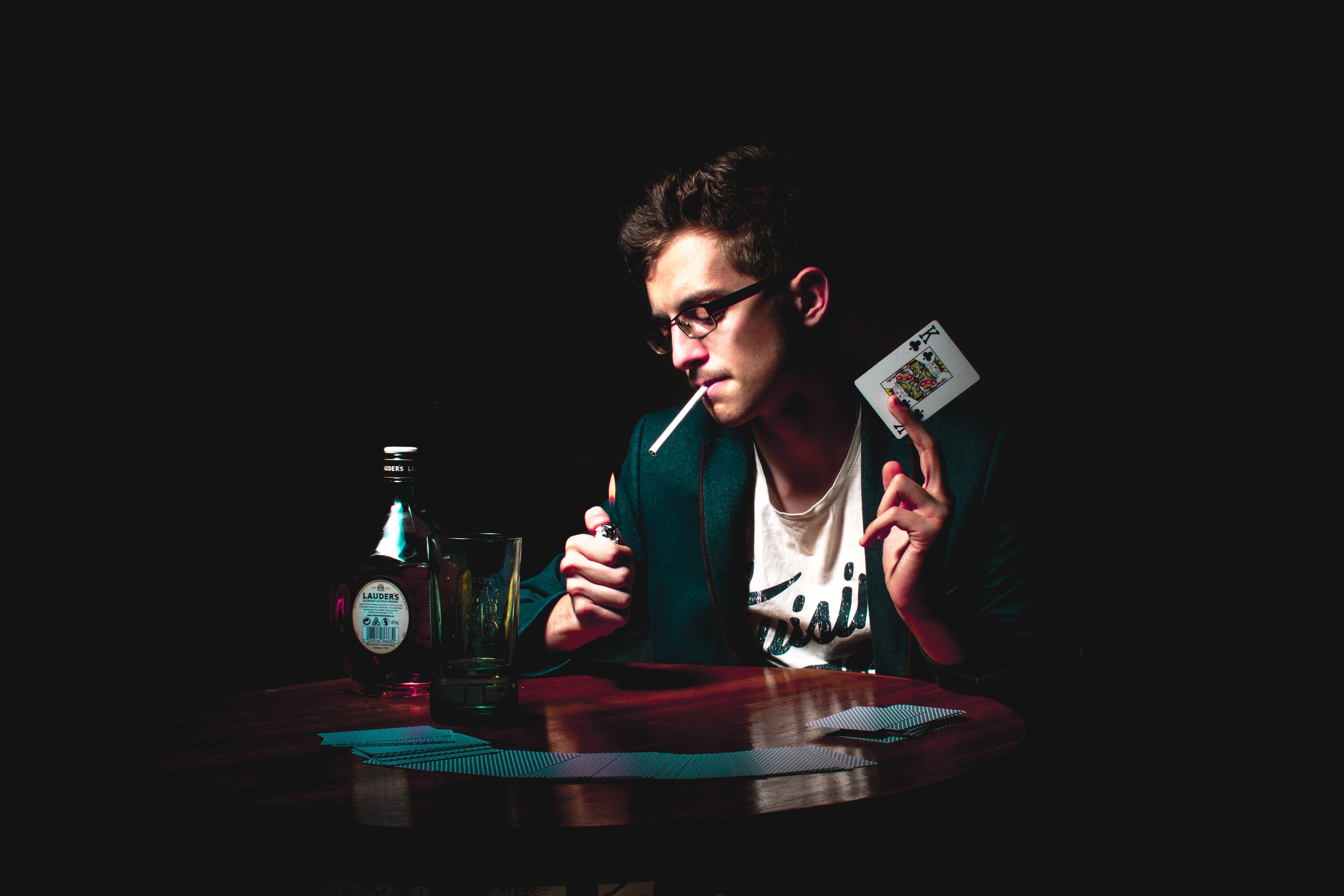
Evasion proved the smarter side of valour. I slipped away to another table like a furtive rat, eager for some space and a place to breathe. She followed. Why the hell had I chosen this casino?

The Game

She sat and asked the time. I made a point of looking at her watch, but she ignored it. I gave her the correct hour but added twenty minutes. She laughed a crescendo.

The Cost

I woke to an empty bed and an emptier wallet. She was long gone. I wasn’t annoyed, though. I blamed myself. She enjoyed her games, always had. I savoured them, too, once, but less so after we married.

THE END

Thank you for reading

Richard

An Inelegant Game

Death was an inelegant solution to an elegant game, an imperfect answer to the most perfect of all solutions. Yet here, Death held no sway.   

Memories were never my forte. I remembered in fits and starts, never then till now, nor here to there. I recalled moments, or fragments of moments, nothing more, like a jigsaw turned upside down and with no means of reference to piece it back together. This was how the first conjunction occurred, grey on black, black on grey, always white in-between. 

The small, white bird was not a creature of feathers and pumping blood, but of glazed porcelain with a copper beak. It sang, though, trilled its little metal heart out. It sang and sang and sang.    

I put the bird in my pocket only to realise many years later, when next I checked, that it had a hole. I panicked then, something to set the heart palpitating. The dull boom, boom, thud of it rang throughout the place, as I searched everywhere except where I ought.   

The second alignment came upon discovering the first of two pits. I peered in one, dropped to my knees for a closer look and almost toppled into the other. In a world of insubstantiality, they were flat, almost symmetrical, two discarded black orbs in a land of dusk. Well, until they blinked.   

They say life comes in threes. Third time lucky and all that. Not for me.   

The sun appeared like a coin from a grandparent’s pocket. You wanted it, needed it, but if you took it too quickly, you might not get another. I had desired the sun since I lost it. She always gleamed. 

She was my little bird, pale with sable hair, which added to her ghostlike appearance. Her eyes were black. No other description fit them. Closing them was the hardest thing I ever did.  

The sun, now bright and beaming like a lighthouse slicing through a stormy midnight, rose higher. It reached its zenith like a diamond in a jet black ring. 

You’re forgiven.’ 

The voice hurt my ears. It rang through my befuddled thoughts like Big Ben’s bells thrust inside my skull. I hated pain. My pain, that was. 

I didn’t answer. I never answered. The words were never quite there. Instead, I wrapped my fogged shawl closer, pulled it tight. Anything else might have killed me.   

(ALMOST AN END)


Photo by Catalin Pop on Unsplash